
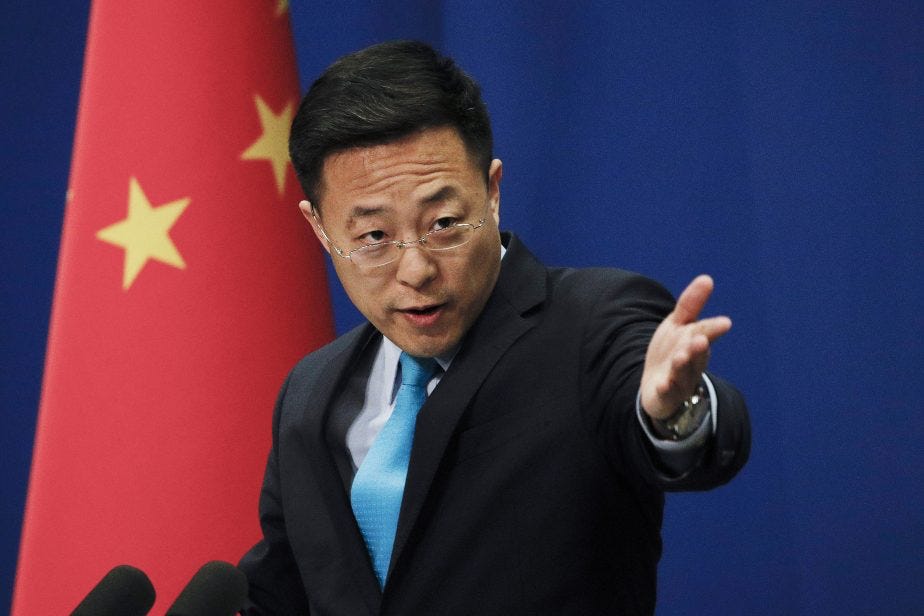
First of all, I want to discuss a “recent“ interview (withheld probably for a couple of months now and under heavy editing because of the way that the Economist or how other news/journalism work).
The topic of this case, the US-Iran conflict, hormuz strait and mentions of what China is or isn’t in relation to world politics. Here is the video;
now, the important question remains. Simply, why western media keep on misunderstanding (or outright underestimating involvment) of china’s strategic gravity or role on the stage of world politics, geopolitics and in geoeconomics.
In a recent interview between The Economist’s Editor-in-Chief Zanny Minton Beddoes and conservative commentator Tucker Carlson, a familiar ideological blind spot reared its head.
When discussing the fallout of Middle Eastern conflicts and who fills the geopolitical void, the establishment consensus immediately pushed back against the idea of Chinese dominance. The logic offered by the Western media anchor was simple, almost predictable: China doesn’t have aircraft carriers stacked in the Gulf. China hasn’t deployed the U.S. Fifth Fleet equivalent. Ergo, China has “no interest” or appetite to act as a serious power broker.
This line of thinking represents a fundamental misreading of modern grand strategy. It measures power through a twentieth-century Western lens—counting military garrisons rather than economic gravity.
The reality? China is already acting as the world’s quiet diplomatic third-party. And it is doing so precisely because its leverage is built on balance sheets, energy purchases, and economic entanglement rather than foreign military bases.
1. The Power of Economic Gravity
Western commentary often treats diplomacy and military power as synonymous. If you aren’t dropping munitions or hosting multi-carrier strike groups, you aren’t “in the game.”
China flips this playbook on its head:
The Ultimate Energy Customer: China is a net energy importer. Disruptions in regional transit choke points—like the Straits of Hormuz—directly threaten its European trade lines and domestic manufacturing.
Leverage Over Tehran: Because China purchases the vast majority of sanctioned Iranian oil, Beijing holds a near-total financial lifeline over Tehran. It doesn’t need to threaten a naval blockade to get an Iranian official to the table; it simply needs to adjust its energy buyback rates or slow down infrastructure investments.
Capital over Carrier Strike Groups: Through long-term strategic partnerships, massive infrastructure acquisitions, and targeted resource buys, Beijing buys structural influence that outlasts military deployments.
When a superpower controls your primary export revenue and finances your essential infrastructure, that superpower doesn’t need a naval base in your backyard to dictate terms. Economic power IS diplomatic power.
2. The Facts Western Media Ignores
The claim that China is a passive bystander with “no appetite” to mediate regional disputes collapses under the weight of recent history:
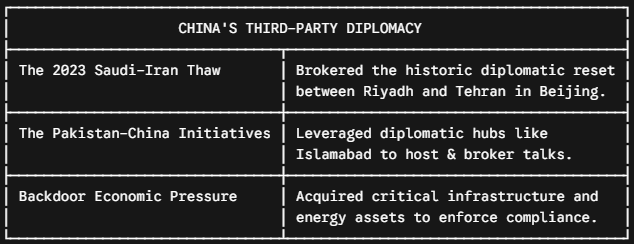
When Beijing step-managed the historic reconciliation between Saudi Arabia and Iran, it sent a shockwave through the foreign policy establishment. It wasn’t Washington or London hosting the handshakes—it was China.
Furthermore, during various regional escalation crises, China repeatedly works through multilateral hubs like Islamabad, deploying quiet, behind-the-scenes pressure to keep transit corridors open and push warring parties toward de-escalation. Even American leadership has had to publicly acknowledge China’s quiet role as an advocate for pushing negotiators to the table.
3. The Shift to True Multipolarity
The core disagreement in interviews like the one on The Economist isn’t actually about China’s physical capabilities—it’s about a refusal to accept the shift to multipolarity.
“If you are getting to the point where you have to exert physical force, you are displaying weakness. What you want is an outcome that benefits you and minimizes threats to you.”
The West’s strategy has historically relied on expensive, overt, and frequently unstable military hegemony. China’s strategy is asymmetric diplomatic intervention:
Let rival powers absorb the massive financial and military cost of regional security.
Step in as the non-aligned, “clean-handed” third party when economics inevitably demand a settlement.
Lock in trade agreements, currency settlement routes, and raw resource access in the aftermath.
Conclusion: A New Era of Mediators
To argue that China isn’t playing a central role as a third-party mediator because it lacks Western-style interventionist instincts is to miss the entire game board.
China doesn’t want to replace the U.S. Navy as the world’s policeman—it wants to be the world’s primary accountant and trading partner. In a world defined by sheer economic gravity, the power to freeze a bank account, pause a multi-billion dollar trade corridor, or buy out strategic assets will settle far more conflicts than an aircraft carrier ever could.
The establishment media can keep looking for Chinese military bases in the desert. Meanwhile, Beijing will keep writing the terms of peace in the boardroom.
Finally
In recent times, this has even extended to the recent strikes on Russian soil by Ukraine—in relation to the Russia-Ukraine conflict. Where China is now issuing serious warnings to Moscow after bomb-strikes on Russian soil.
As Ukrainian drone and missile strikes reach deeper into Russian energy infrastructure, triggering intense chatter among Russian media and hardliners regarding drastic or nuclear retaliation, it is Beijing that has stepped into the room as the decisive voice.
China’s firm and unequivocal warnings to Moscow against further military escalation (or even in entertaining the mere thought of nuclear options), showcase how its economic leverage over Russia gives it unmatched mediating authority.
Moscow relies heavily on Chinese trade, manufacturing and tech imports to sustain its economy (especially after being cut-off from the western world and being under hard economic sactions from much of the developed world).
Consequently, when Beijing draws a firm red line against uncontrolled escalation, Moscow has no choice but to listen. This quiet yet potent leverage over a nuclear power proves that China’s role as the diplomatic third-party isn't limited only to the Middle East — rather, it is rapidly reshaping the security architecture of Eastern Europe as well.